








New Publication
Temperature at Roque de los Muchachos rose 1.1 ºC in 20 years, twice as much as predicted by climate models
October 31, 2024
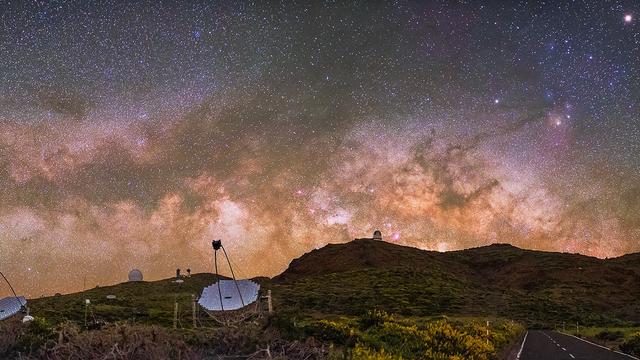
Gamma-ray GroupThe meteorological data recorded over the past two decades by sensors of the Roque de los Muchachos astronomical observatory facilities point to a rise of 1.1 ºC in the average temperature. The analysis shows more than double the increase predicted by climate models for the same area, and even more than expected for the next 20 years.
Researchers analyzed 20 years of weather data from the MAGIC telescopes at the CTAO-North site, revealing a 1.1ºC temperature rise—over double the rate predicted by climate models. IFAE researcher Oscar Blanch collaborated in the study, which highlights concerning climate trends impacting observatories worldwide. The findings emphasize the importance of monitoring climate changes at remote scientific facilities.
Detailed analysis of local climate at the CTAO-North site on La Palma from 20 yr of MAGIC weather station data , M. Gaug , A. Longo, S. Bianchi, L. Font, S. Almirante et al., Monthly Notices of the Royal Astronomical Society, Volume 534, Issue 3, November 2024, Pages 2344–2377
Recognition
2026 Nobel Prize in Physics: the birth of high-energy neutrino astronomy
October 7, 2026
The 2026 Nobel Prize in Physics recognises Francis Halzen’s pioneering role in high-energy neutrino astronomy. IFAE is connected to this achievement through MAGIC’s contribution to identifying a likely cosmic neutrino source.
Publication
IFAE-developed readout system successfully tested at CERN for future space telescopes
September 3, 2026
IFAE researchers have developed a scalable readout system for silicon photomultiplier detectors, successfully tested in beam campaigns at CERN. The technology could contribute to future space-based gamma-ray and cosmic-ray telescopes such as HERD and FOCUS.