







Milestone
Cavern Excavation Completed for Hyper-Kamiokande
September 1, 2025
Neutrinos GroupThe completion of the underground cavern for Hyper-Kamiokande in Japan marks a key research milestone in the construction of a next-generation neutrino observatory. The Institut de Física d’Altes Energies (IFAE) participates in the project through its Neutrino group, contributing to detector development and the scientific programme of this major international research infrastructure.
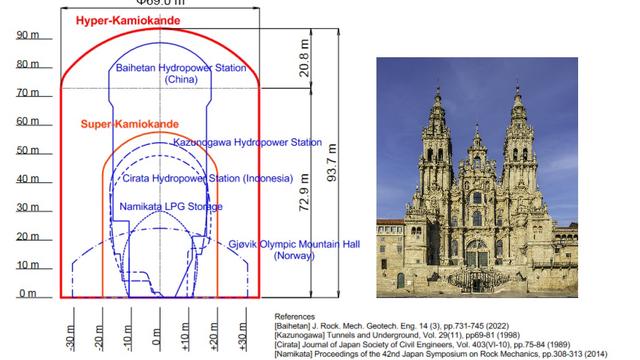
Hyper-Kamiokande (Hyper-K) is a next-generation water Cherenkov detector with a fiducial volume more than eight times larger than its predecessor, Super-Kamiokande. Equipped with over 20,000 newly developed photodetectors, the experiment will enable precision studies of neutrino properties, searches for proton decay, and investigations of some of the most fundamental questions in particle physics and cosmology.
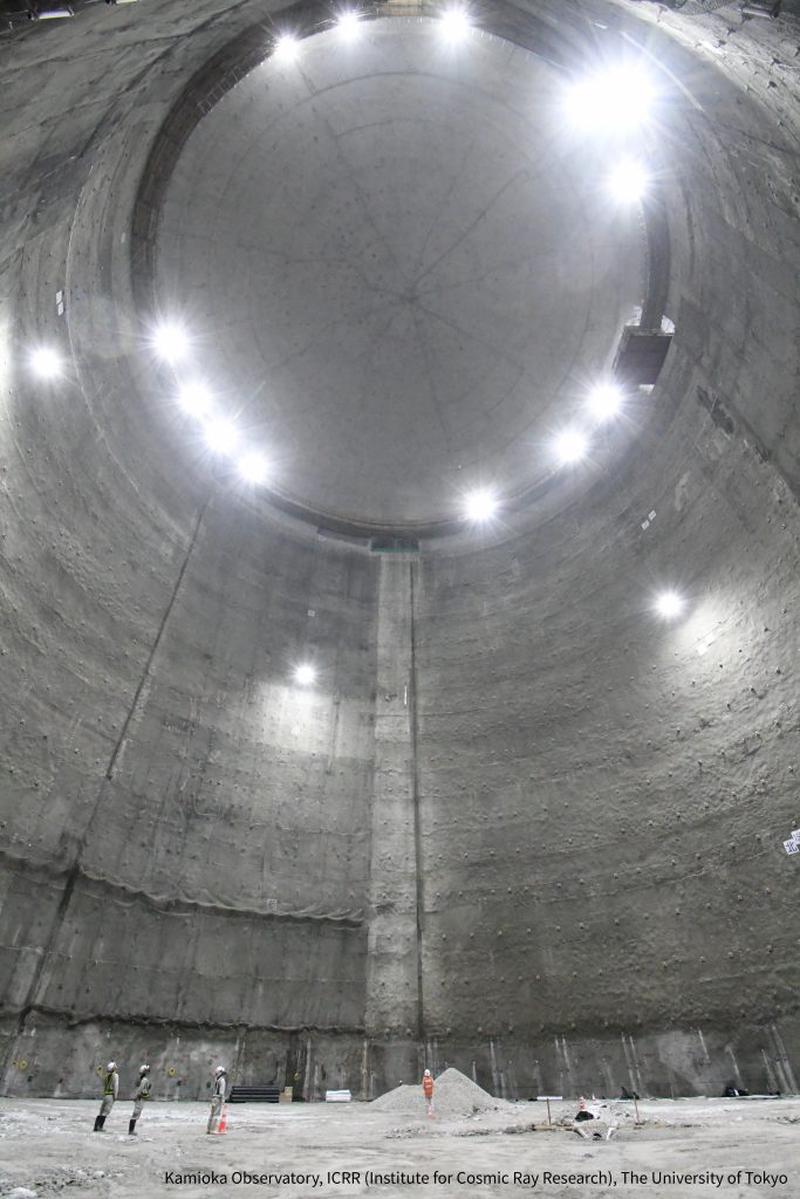
The underground cavern, located 600 metres below ground in Hida City, Gifu Prefecture, was completed on 31 July 2025. This milestone marks the end of a critical preparatory phase and enables the next stage of the project, which will transform the cavern into a giant tank containing 260,000 cubic metres of ultra-pure water, where the Hyper-Kamiokande detector will be constructed and instrumented. The experiment is scheduled to begin operations in 2028.
The Hyper-Kamiokande project brings together around 630 scientists from 22 countries. The Institut de Física d’Altes Energies (IFAE) participates in the experiment through its Neutrino group, a consolidated research line dedicated to the experimental study of neutrino properties and to contributions to large international neutrino facilities. The group contributes to detector technology development and to the scientific exploitation of the experiment, and is led by Thorsten Lux, an IFAE researcher who holds positions of scientific responsibility within the Hyper-Kamiokande collaboration. This involvement positions IFAE as an active contributor to one of the flagship research infrastructures in next-generation neutrino physics.