







New Publication
An updated Standard Model prediction for the muon anomalous magnetic moment
September 11, 2025
Theory DivisionA recent theoretical study published in Physics Reports, titled “The anomalous magnetic moment of the muon in the Standard Model: an update ”, presents a revised calculation within the Standard Model of Particle Physics of the muon anomalous magnetic moment, known as muon g-2.
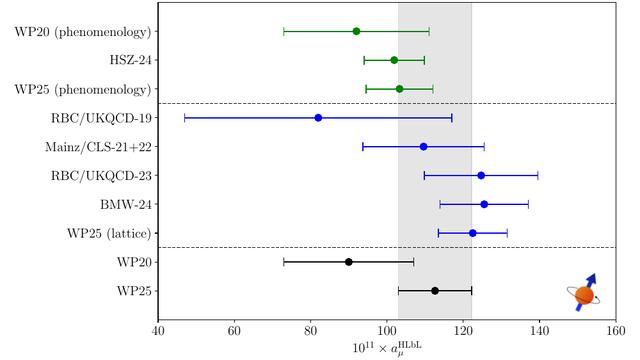
The work is part of a broad international effort and includes contributions from researchers of the Standard Model group in the Theory Division of the Institut de Física d’Altes Energies (IFAE): Pere Masjuan, Alejandro Miranda, and Santiago Peris. The study reports that the updated Standard Model prediction shifts upward relative to previous estimates, bringing it into agreement with current experimental measurements.
The muon g-2 quantifies how the magnetic moment of the muon deviates from the value expected for a point-like particle. This deviation arises from quantum fluctuations involving all sectors of the Standard Model, including electromagnetic, weak, and strong interactions. Because the muon is much heavier than the electron, these quantum effects are enhanced, making g-2 of the muon particularly sensitive to higher-order corrections.
While the experimental value of the muon g-2 can be measured with very high accuracy (at the level of few parts per billion), its theoretical prediction is more challenging. Contributions from the strong interaction at low energies dominate the theoretical uncertainty by far. In recent years, substantial progress in lattice QCD calculations has improved the determination of these hadronic contributions, enabling a different Standard Model prediction.
Previous comparisons between theory and experiment—most notably with measurements from the Muon g-2 experiment at Fermilab —had suggested a discrepancy that attracted wide interest as a possible indication of physics beyond the Standard Model. The new analysis revisits the theoretical prediction by incorporating these recent advances from lattice QCD, Doing so, however, the theoretical contributions based on the experimental results from e+e- data have been abandoned. Current Standard Model prediction then differs from the previous prediction by having changed the way the Standard Model is defined.
As a result, the updated Standard Model prediction is numerically higher than these earlier estimates and is now consistent with the experimental value at the current level of precision. At present, the muon g-2 based on lattice QCD results therefore no longer indicates a significant tension between theory and experiment, while continuing to serve as a stringent test of the Standard Model as both experimental measurements and theoretical calculations move toward even higher precision.