








New Publication
IFAE researchers present a new Lyman-α forest study of cosmic expansion
September 18, 2025
Observational Cosmology GroupResearchers from the Observational Cosmology Group at the IFAE have presented a new cosmological analysis based on measurements of the Lyman-α forest, providing precise information on the expansion of the Universe at high redshift.
The study has been co-led by Andreu Cuceu (LBNL), Hiram Herrera-Alcantar (CEA Saclay) and Calum Gordon (IFAE) with contributions from an international team, and forms part of the ERC project COSMOLYA , led by IFAE researcher Andreu Font-Ribera.
The analysis is based on data from the Dark Energy Spectroscopic Instrument (DESI) collaboration, using observations from its first public data release (DR1). DESI is an international experiment designed to map the large-scale structure of the Universe by measuring the spectra of millions of galaxies and quasars, enabling detailed studies of cosmic geometry and expansion across a wide range of epochs. The results have been published on arXiv as “DESI DR1 Lyman-α forest: 3D full-shape analysis and cosmological constraints " and constitute one of the most detailed three-dimensional analyses of Lyman-α forest clustering performed to date using DESI data.
Mapping the Universe with the Lyman-α forest
The Lyman-α forest is a pattern of absorption lines observed in the spectra of distant quasars, produced as their light passes through diffuse clouds of neutral hydrogen in the intergalactic medium. These clouds trace the underlying distribution of matter in the Universe, making the Lyman-α forest a powerful probe of large-scale structure at early cosmic times.
Because these absorption features are observed at redshifts around z ≈ 2–3, they allow researchers to study the Universe when it was only a few billion years old. By analysing correlations in the absorption pattern across many lines of sight, it is possible to extract geometric information related to cosmic distances and the expansion history of the Universe in a regime that is difficult to probe with galaxy surveys alone.
A three-dimensional full-shape analysis
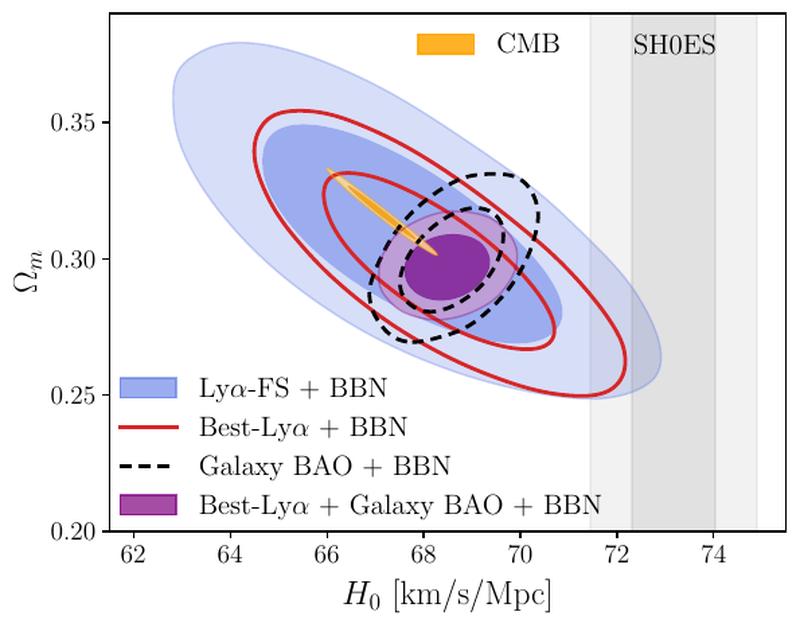
In this work, the team carried out a three-dimensional full-shape analysis of Lyman-α forest correlations, going beyond traditional approaches that focus on specific features such as baryon acoustic oscillations. By exploiting a larger fraction of the statistical information contained in the data, the analysis achieves improved precision in measurements of cosmological distances at high redshift.
Within the framework of the standard cosmological model, the results are consistent with previous measurements from other large-scale structure probes and observations of the cosmic microwave background. The study highlights the potential of Lyman-α forest analyses for precision cosmology as DESI continues to deliver increasingly large datasets.
IFAE, COSMOLYA and DESI
IFAE plays a leading role in Lyman-α forest cosmology through the ERC project COSMOLYA, which focuses on developing advanced analysis techniques to extract cosmological information from observations of the intergalactic medium. This work is part of IFAE’s broader contribution to DESI, which includes data analysis, modelling and interpretation of cosmological observables, as well as technological contributions to the instrument.
Consolidation grant
Carles Sánchez obtains a Consolidación Investigadora grant
February 4, 2026
Carles Sánchez, member of the Observational Cosmology Group at the Institut de Física d’Altes Energies, has obtained a Consolidación Investigadora grant from the Spanish Ministry of Science through the UAB (Departament de Física, Unitat d’Altes Energies).
New ICREA position
Andreu Font-Ribera appointed ICREA Professor at IFAE
January 14, 2026
Andreu Font-Ribera has been appointed ICREA Research Professor at the Institut de Física d’Altes Energies (IFAE), reinforcing the institute’s leadership. With this appointment, IFAE now hosts eight ICREA professors.