








Gravitational Waves
Spain strengthens its participation in major gravitational-wave infrastructures
December 10, 2025
Gravitational Waves GroupThe Spanish Ministry of Science, Innovation and Universities has allocated new funding to Spain’s participation in major international gravitational-wave infrastructures, with the Institut de Física d’Altes Energies (IFAE) designated as the institution through which these contributions will be channelled.
A significant portion of the funding is directed to activities linked to the Einstein Telescope (ET), the future third-generation European gravitational-wave observatory included in the ESFRI Roadmap since 2021. IFAE coordinates the Einstein Telescope Preparatory Phase (ET-PP) project, funded by the European Commission, and is part of the directorate of the Einstein Telescope Organisation (ETO). In this role, IFAE represents Spain in collaboration agreements with CERN, INFN (Italy) and Nikhef (Netherlands) covering civil engineering studies, vacuum systems and the functional design of the observatory. The funds allocated by the Spanish Ministry will enable Spain to meet its commitments in these international agreements and to reinforce its contribution to the ET technical design.
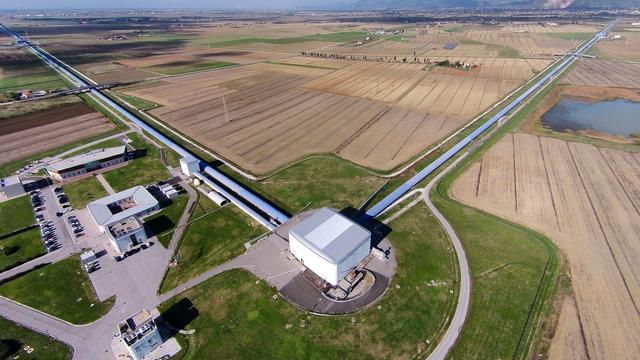
A second part of the funding supports Spain’s institutional involvement in the European Gravitational Observatory (EGO), which operates the Virgo interferometer in Cascina (Italy) and coordinates the European gravitational-wave detection network. Spanish research groups —including IFAE, CIEMAT, ICCUB, the University of Valencia and the IFT— have long contributed scientifically to Virgo. The funds allocated by the Ministry enable increased technical participation in Virgo operations and future upgrades —including maintenance of scientific systems, computing infrastructure and coordination activities.
Results
LIGO–Virgo–KAGRA complete their richest gravitational-wave observation run to date
November 18, 2025
The LIGO–Virgo–KAGRA (LVK) Collaboration has announced the completion of O4, the most productive gravitational-wave observation run so far, yielding an unprecedented number of candidate events and high-quality data for the scientific community.