








Event
IFAE's Severo Ochoa programme brings jazz, history and physics together in a sold-out public event
July 10, 2026
IFAEA sold-out audience of around 300 people gathered for ‘Sota l’eclipsi: jazz i física de l’univers’, an outreach event supported by IFAE’s Severo Ochoa Centre of Excellence programme. Bringing together history, fundamental physics and live jazz, the evening explored how eclipses have transformed our understanding of the Universe while highlighting the dialogue between scientific discovery and artistic creation.
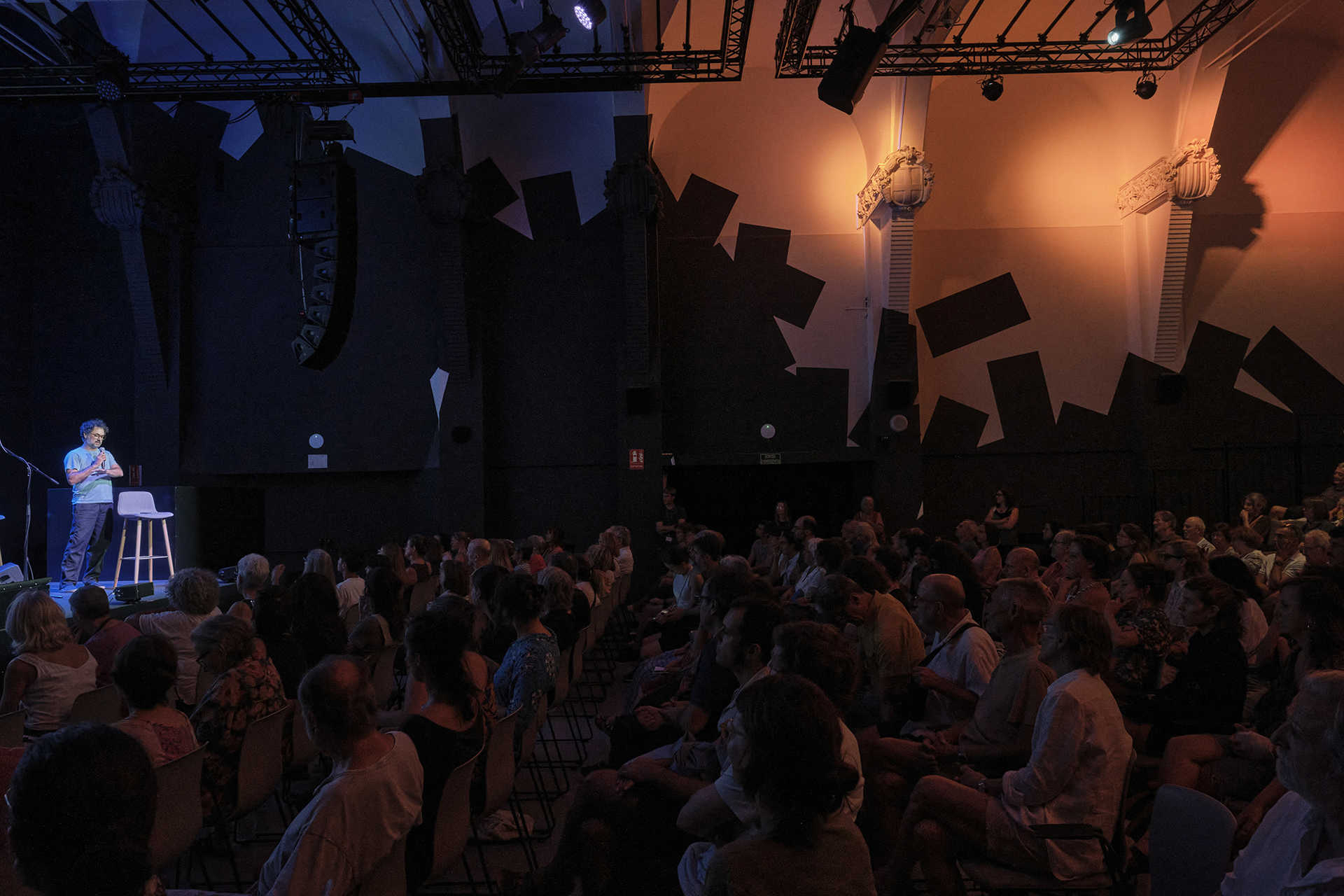
Around 300 people gathered yesterday for Sota l’eclipsi: jazz i física de l’univers, a public outreach event jointly organised by IFAE and the Centre de Cultura Contemporània de Barcelona (CCCB). The event sold out, reflecting the public interest in initiatives that connect scientific research with history, culture and the performing arts. It formed part of the 2026 edition of the CCCB’s Ciència Radical programme and was co-funded through IFAE’s Severo Ochoa Centre of Excellence programme (CEX2024-001441-S), which supports research excellence together with outreach activities that strengthen the connection between science and society.
Inspired by the total solar eclipse that will cross Spain on 12 August 2026, the evening explored how eclipses have shaped both our understanding of the Universe and our cultural imagination. Moderated by Sebastián Grinschpun (IFAE), the event featured science historian Cristina Sans Ponsetí (UAB), ICREA researcher Diego Blas (IFAE), and the Néstor Giménez Trio—Néstor Giménez (piano), Camil Arcarazo (double bass) and Andreu Moreno (drums)—in a dialogue between history, fundamental physics and live jazz.
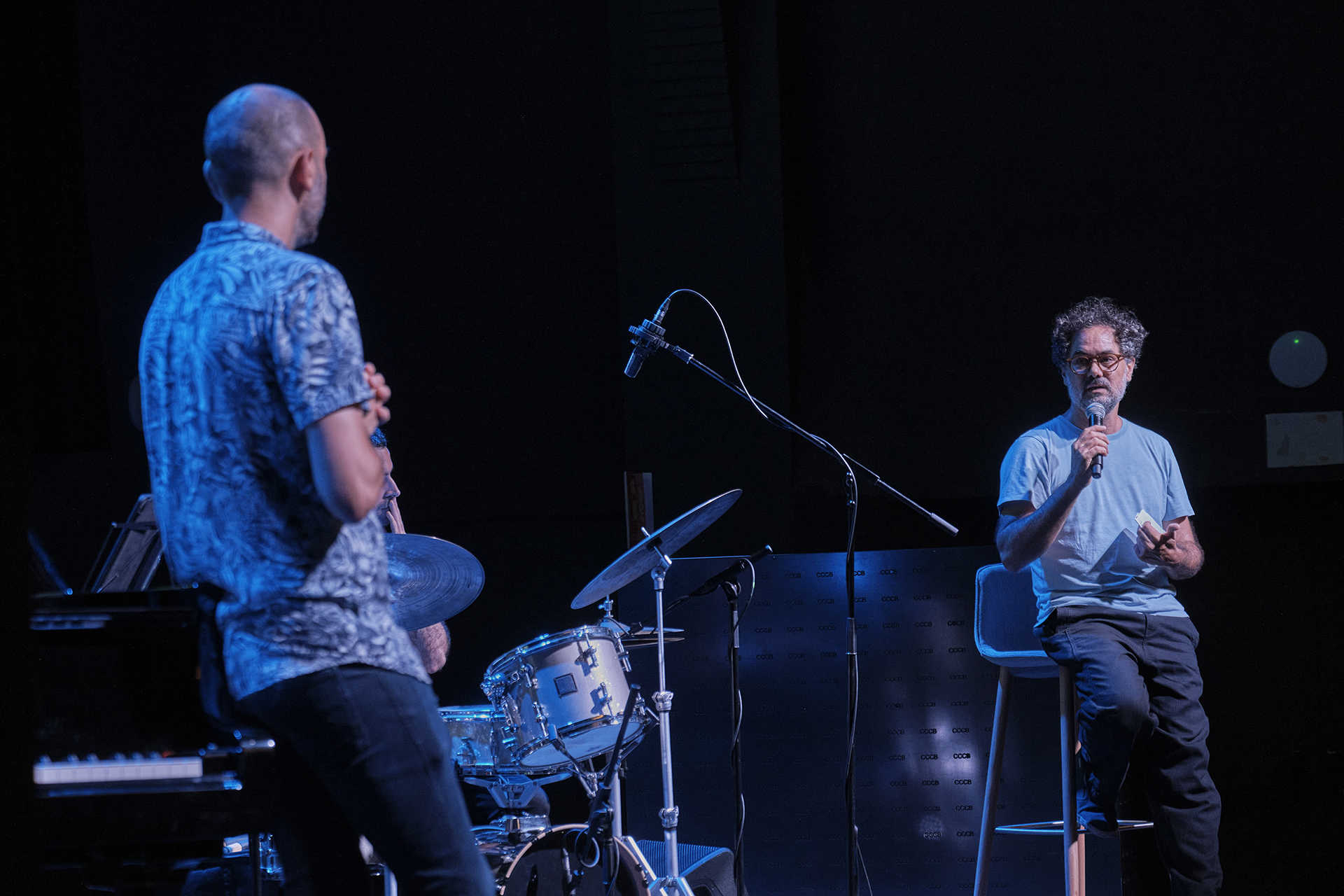
Cristina Sans Ponsetí opened the evening by examining how eclipses have contributed to the history of science. Using examples such as the discovery of helium during the 1868 solar eclipse and the 1919 expedition that tested Einstein’s General Theory of Relativity, she showed how scientific knowledge emerges through a complex collective process, rather than through the work of a lone genius. Her talk highlighted the close relationship between science, culture and society in the development of new ideas.
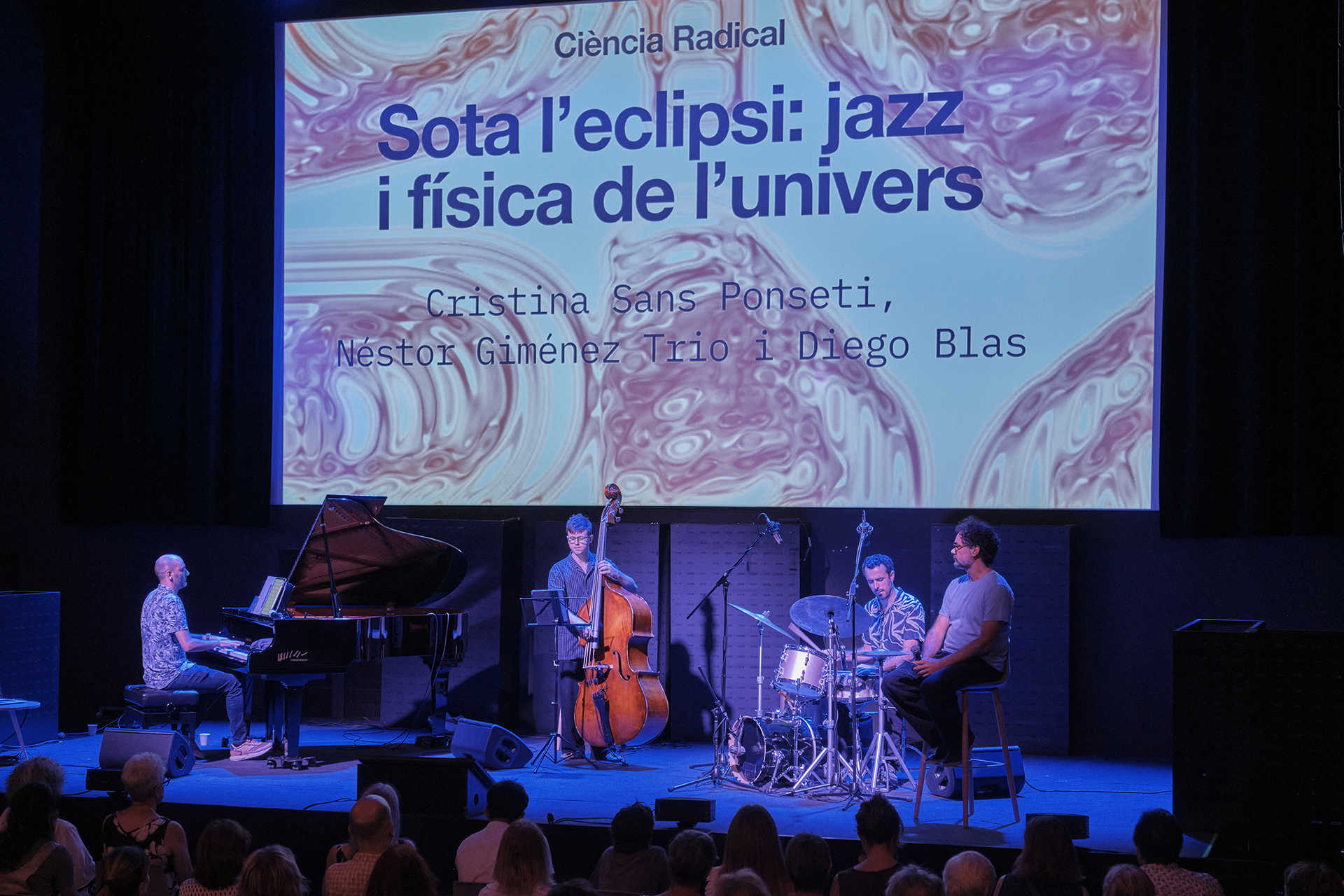
The second half of the evening brought together the Néstor Giménez Trio and Diego Blas in a dialogue between music and physics. The trio performed a series of original compositions inspired by concepts from modern physics, with each piece serving as the starting point for a conversation with Blas about the scientific ideas behind the music and their interpretation through both physics and artistic creation. Topics ranged from gravity and curved space-time to the speed of light and the different cosmic messengers, illustrating how music and science can offer complementary perspectives on the same phenomena.
The programme concluded with a piece composed exclusively for the event, inspired by the forthcoming total solar eclipse of 12 August 2026. Accompanied by a projection of eclipse images, the performance brought together music, astronomy and visual imagery, returning to the phenomenon that had inspired the dialogue between history, physics and art.
The strong attendance reflects the public interest in activities that connect scientific research with history, culture and the arts. Through the Severo Ochoa Centre of Excellence programme, IFAE continues to support outreach initiatives that bring contemporary physics to wider audiences.
Credits of all images: CCCB, 2026 / CC BY-NC-SA Oriol Clavera
Event
IFAE brings physics to CosmoCaixa for the European Researchers’ Night 2026
September 17, 2026
IFAE will bring fundamental physics closer to the public at CosmoCaixa during the European Researchers’ Night 2026, with activities developed within the European Project PICO New Horizons, including an interactive cosmology workshop for families and a live jazz and physics performance.