








Highlight
LST-1 and MAGIC reveal new insights into the most distant very-high-energy blazar
September 2, 2026
Joint observations by LST-1 and MAGIC have characterised the extraordinary gamma-ray flare of OP 313, located about eight billion light-years away and the most distant blazar ever detected at very high energies.
The observations provide new constraints on the extragalactic background light and shed light on the mechanisms that accelerate particles to extreme energies in the jet produced by the galaxy’s central supermassive black hole.
The result builds on the first very-high-energy detection of OP 313 by LST-1 in 2023, in which the IFAE Gamma-ray Group was already involved through its responsibilities in the telescopes. IFAE contributes to LST-1 and MAGIC through instrumentation, telescope operation and data-analysis software.
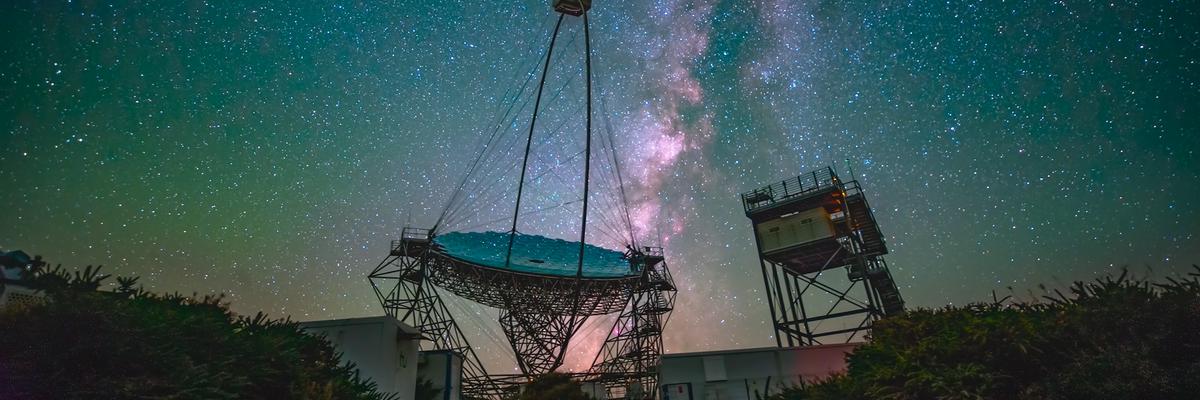
The LST-1 and MAGIC telescopes have provided the most detailed observations yet of OP 313, the most distant blazar ever detected at very high gamma-ray energies.
The new study, published in Astronomy & Astrophysics, follows the first detection of OP 313 at very high energies by LST-1 in December 2023. Located at a redshift of z = 0.997, the source emitted the gamma rays observed on Earth around eight billion years ago.
Combining observations from LST-1 and MAGIC with data at lower energies, researchers have now characterised the exceptional flare that made this detection possible. The results provide information about the physical processes operating close to the supermassive black hole at the centre of OP 313 and place new constraints on the extragalactic background light encountered by the gamma rays during their journey across the Universe.
The research is published in Astronomy & Astrophysics .

An extreme source eight billion light-years away
Blazars are a particularly bright class of active galactic nuclei: galaxies whose central regions are powered by matter falling onto a supermassive black hole. They produce powerful jets of particles travelling at close to the speed of light, and when one of these jets points approximately towards Earth, the galaxy can appear exceptionally bright.
OP 313 belongs to a subclass known as flat spectrum radio quasars, among the most luminous and powerful emitters in the Universe.
In December 2023, OP 313 underwent an extraordinary flare. LST-1 detected very-high-energy gamma rays from the source for the first time, establishing it as the most distant active galactic nucleus ever detected at these energies. The initial discovery was announced at the time through an Astronomer’s Telegram and was reported by IFAE in January 2024 .
The newly published analysis combines those observations with MAGIC data obtained during the flare and subsequent lower-activity period, together with observations at lower energies from other instruments.
Using gamma rays to probe the light between galaxies
Detecting very-high-energy gamma rays from such a distant source is particularly challenging.
During their journey through the Universe, gamma rays interact with the extragalactic background light (EBL), the accumulated radiation produced by stars, galaxies and other cosmic sources throughout the history of the Universe.
When a sufficiently energetic gamma ray interacts with a photon from this background light, the two can produce an electron and a positron. The process progressively reduces the number of gamma rays that reach Earth, meaning that the Universe becomes increasingly opaque to very-high-energy radiation at greater distances.
The exceptional distance of OP 313 therefore makes the source a powerful probe of the EBL. By analysing the spectrum measured by LST-1 and MAGIC, together with observations at lower energies, researchers were able to place stringent constraints on the density of this background radiation.
Inside the jet of OP 313
The observations also allow researchers to investigate what produced the extraordinary flare.
The study finds that the gamma-ray emission can be explained by a scenario in which electrons are accelerated to relativistic speeds inside the powerful plasma jet launched from the vicinity of the central supermassive black hole.
These electrons interact with lower-energy photons surrounding the black hole and transfer part of their energy to them, boosting the photons to very high gamma-ray energies.
The extensive observations therefore provide new information about the mechanisms responsible for particle acceleration and high-energy emission in flat spectrum radio quasars.