








Highlight
Prof. Mario Martínez named new Director of IFAE
September 7, 2026
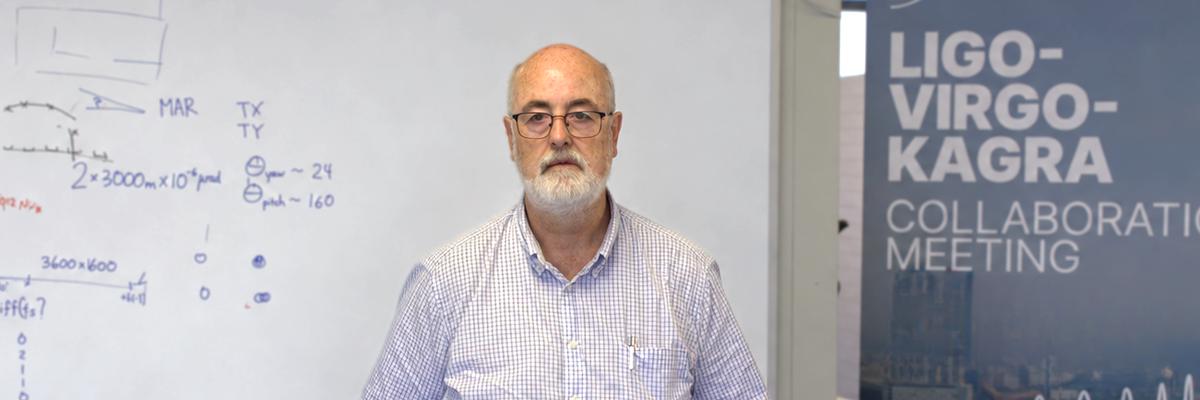
IFAE’s Governing Board nominated Prof. Mario Martínez as the new director of the Institut de Física d’Altes Energies (IFAE) at its meeting on September 4, 2026. He will take office on November 1, 2026.
Mario Martínez will be the fifth director of IFAE, succeeding Prof. Eugenio Coccia, who has led the institute since November 2022. Previous directors of IFAE were Ramon Miquel (2015–2022), Matteo Cavalli-Sforza (2008–2014) and Enrique Fernández, founder and first director of IFAE (1991–2008).
Mario Martínez is an ICREA Research Professor and has been Deputy Director of IFAE since 2023. He has been at the institute for more than two decades and has held several scientific and management responsibilities at IFAE and within major international research collaborations.
About Mario Martínez
Mario Martínez is an experimental physicist whose career spans particle physics and gravitational-wave research. He joined IFAE in 2004, following research positions at DESY in Germany and Fermilab in the United States.
At IFAE, Mario Martínez established a research group working on the CDF experiment at Fermilab. In 2009, the ATLAS and CDF teams at IFAE merged into a single group, led by Mario Martínez. His research in collider physics included searches for new phenomena at the energy frontier. In 2019, Mario Martínez, together with other IFAE researchers, received the European Physical Society High Energy and Particle Physics Prize as a member of the CDF and D0 collaborations.
Throughout his career, Mario Martínez has held a number of scientific leadership positions at both national and international level. He served as Director of IFAE’s Experimental Division, as Scientific Manager of the Spanish High Energy Physics programme, and as Scientific Delegate of Spain at the CERN Council. Mario Martínez has also served on scientific committees at CERN, including the LHC experiments committee (LHCC). Since 2025, Mario Martínez has been the Scientific Director of IFAE’s Severo Ochoa Centre of Excellence programme, which supports strategic actions in research, innovation and infrastructure to strengthen IFAE’s leadership in fundamental physics and increase its societal impact.
In 2018, Mario Martínez led the creation of a new research line in gravitational-wave physics at IFAE and currently leads the IFAE Gravitational Waves Group. The group participates in the Virgo and LIGO collaborations and works on detector instrumentation, data analysis and fundamental physics. A recent milestone was the installation in Virgo of two large instrumented baffles designed and built by IFAE . The systems, each equipped with 120 sensors, provide new capabilities for monitoring stray-light noise and characterising detector performance, and culminate more than seven years of development led by the IFAE gravitational-wave group under the coordination of Mario Martínez.
Mario Martínez has also played a leading role in the development of the Einstein Telescope (ET), Europe’s future third-generation gravitational-wave observatory. In 2020–2021, Mario Martínez led the efforts of the Spanish scientific community that resulted in Spain formally supporting the ET candidature as an ESFRI research infrastructure and its inclusion in the ESFRI Roadmap in 2021. Mario Martínez is also a member of the ET Directorate.
From 2022 to 2026, Mario Martínez coordinated the Horizon Europe Einstein Telescope Preparatory Phase (ET-PP) , a €3.45 million European project coordinated by IFAE that established key scientific, technical, governance and organisational foundations for the future observatory.
Mario Martínez has supervised 18 PhD theses to date and has played an active role in the organisation and governance of international particle-physics and gravitational-wave research throughout his career.
- IFAE Research group
- Gravitational Waves Group
- Contact