







Publication
A new approach to searching for ultraheavy dark matter
September 9, 2026
Theory DivisionThe study “First Search for Ultraheavy Dark Matter Using a Magnetically Levitated Particle” , co-authored by IFAE researcher Dorian Amaral and collaborators, explores a new experimental approach to probing interactions of ultraheavy dark matter. The work has been reported on Phys.org
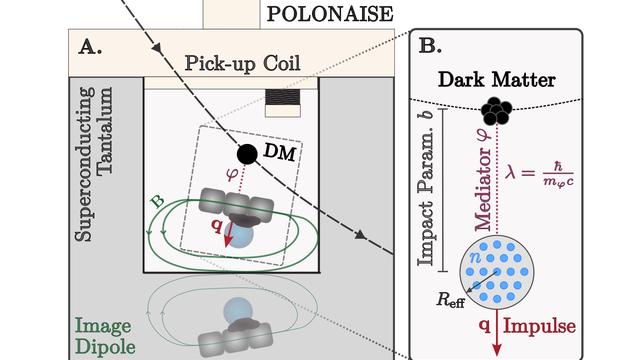
The experiment uses an extremely sensitive force sensor based on a tiny permanent magnet levitated above a superconductor. Rather than looking for the energy deposited to microscopic atoms by conventional dark matter candidates in large particle detectors, the experiment searches for the minute impulse that an ultraheavy dark matter particle could produce as it passes close to a macroscopic sensor.
Dorian Amaral, a postdoctoral researcher in IFAE’s Theory Division, is corresponding author of the study. Before joining IFAE, he worked at Rice University, where he investigated how magnetic levitation and precision sensing technologies could be used to search for dark matter and other extremely weak new interactions.
Looking for dark matter at the opposite end of the mass scale
The experiment uses a milligram-scale ferromagnet levitated in a superconducting trap, making it sensitive to extremely small forces and sudden momentum transfers. No evidence for an ultraheavy dark matter interaction was found, but the result constrains previously unexplored combinations of dark matter mass and interaction strength.
The work also complements earlier research by Amaral and collaborators using magnetic levitation to search for ultralight dark matter, showing how the same class of highly sensitive sensors can probe very different regions of the possible dark matter landscape.
Quantum sensors as probes of fundamental physics
At IFAE, Amaral is continuing to explore how precision and quantum sensing techniques can be used to address fundamental questions in physics. His research forms part of a broader effort within the Theory Division to develop new experimental concepts and sensing technologies capable of probing phenomena that are difficult to access with conventional instruments, from dark matter to gravitational waves and other possible signatures of new physics.
Amaral is also part of GravNet , an ERC Synergy Grant project co-led by ICREA Research Professor Diego Blas. With Blas, postdoctoral researchers Jordan Gué and Tom Krokotsch, and PhD students Yuliia Borysenkova and Tomas Kvietkauskas, he is helping to design one of the world’s most sensitive experiments for gravitational waves at megahertz to gigahertz frequencies. No known astrophysical source can radiate in this band, so a signal there would point to something far more exotic, such as merging primordial black holes created in the first instants after the Big Bang. GravNet plans to install a network of electromagnetic cavities spread across European laboratories to search for these signals. In parallel, the wider group is studying how atomic clocks, atom interferometers, and even the motion of the Moon can be used to help answer fundamental questions about how our Universe works.
“First Search for Ultraheavy Dark Matter Using a Magnetically Levitated Particle” is authored by Dennis G. Uitenbroek, Dorian W. P. Amaral, Juehang Qin, Jurriaan Langendorff, Andrew Gingerich, Tjerk H. Oosterkamp and Christopher D. Tunnell. https://arxiv.org/abs/2608.20464