








Highlight
Four Large-Sized Telescopes to be inaugurated at CTAO-North in La Palma
September 17, 2026
- On 15 October 2026, the CTAO Large-Sized Telescope Collaboration will inaugurate the complete array of four Large-Sized Telescopes (LSTs) at the CTAO-North site on La Palma. The event will mark the completion of the construction of all LSTs foreseen for the northern site of the Cherenkov Telescope Array Observatory (CTAO).
- IFAE’s Gamma-ray Group has played a significant role in the project, contributing to its scientific and technical coordination, the integration of the telescope cameras and the development of the software used to analyse their data.
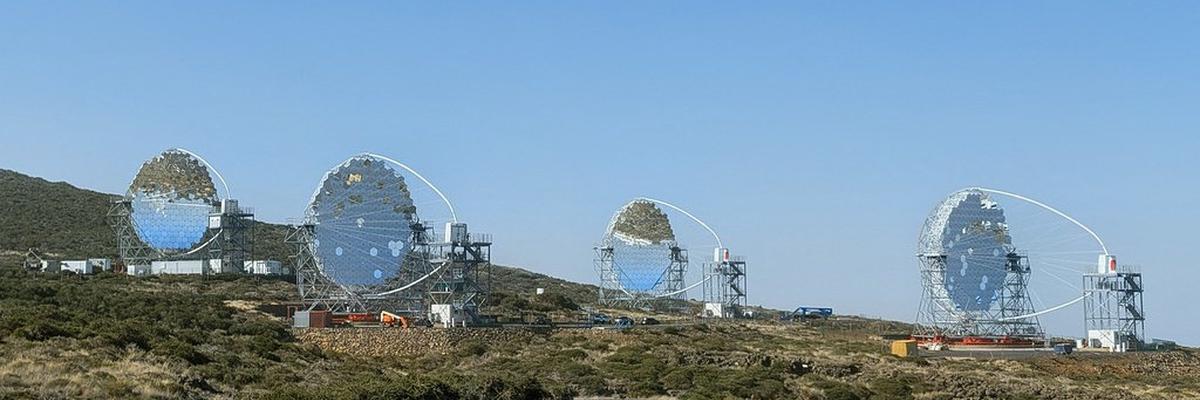
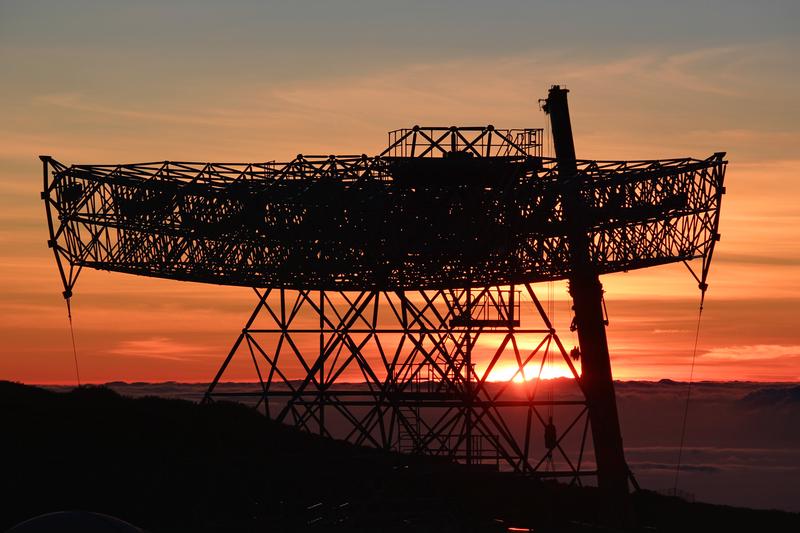
On 15 October 2026, the Large-Sized Telescope Collaboration will officially inaugurate the complete four-telescope LST array at the Observatorio del Roque de los Muchachos in La Palma. The main ceremony, starting at 11:30, will include the inauguration of the three new telescopes that join LST-1, inaugurated in 2018, to complete the LST array foreseen for CTAO-North. The programme will also include a guided visit to the telescopes and a press briefing.
The inauguration represents a major milestone in the development of the Cherenkov Telescope Array Observatory (CTAO), which is being built to become the world’s largest and most powerful ground-based gamma-ray observatory. CTAO will use three types of telescopes — Large-Sized Telescopes (LSTs), Medium-Sized Telescopes (MSTs) and Small-Sized Telescopes (SSTs) — distributed between CTAO-North, in La Palma, and CTAO-South, at ESO’s Paranal Observatory in Chile. Together, they will cover an energy range extending approximately from 20 GeV to 300 TeV.
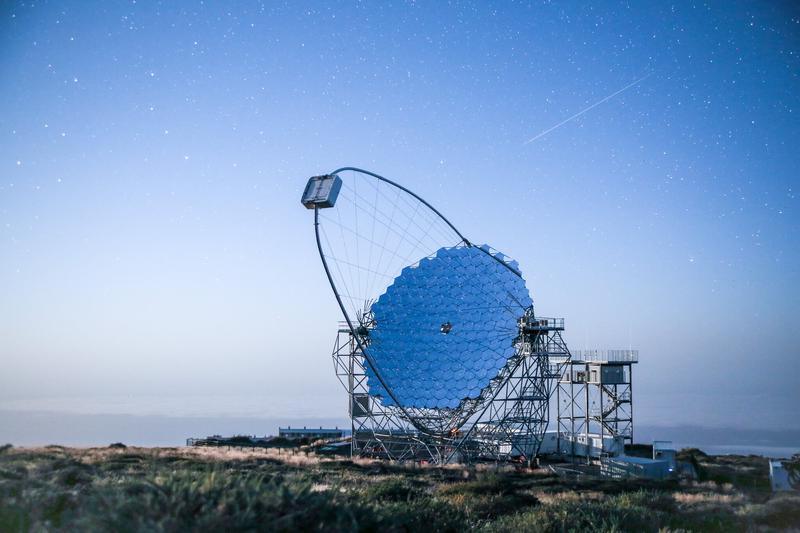
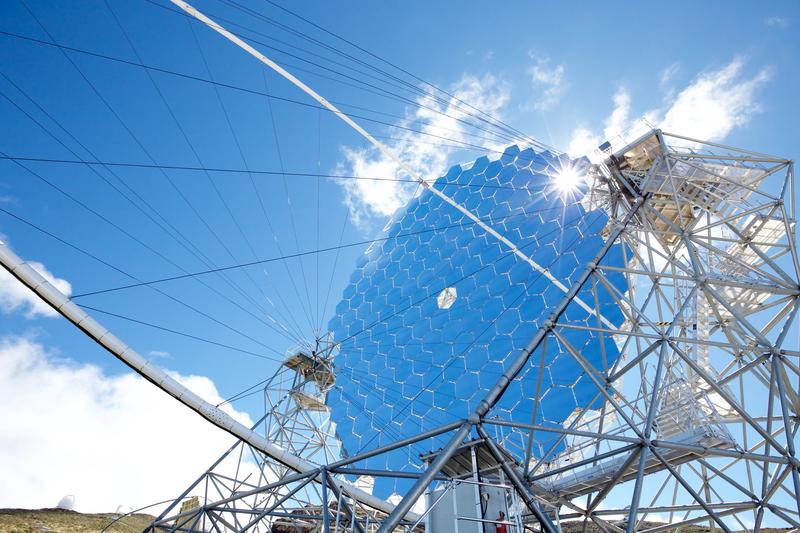
The LSTs are designed to provide CTAO with its sensitivity at the lowest energies. Their 23-metre reflectors collect the faint flashes of Cherenkov light produced when gamma rays interact with the Earth’s atmosphere. Despite standing around 45 metres high and weighing approximately 100 tonnes, each telescope can reposition itself to any point in the sky in less than 20 seconds, making the LSTs particularly well suited to observing rapidly changing astrophysical phenomena.
The Spanish contribution to the LST project
Spain plays a major role in the LST project. Together with Japan, it is one of its two largest national contributors, accounting for approximately 32% of the project. Spain also hosts CTAO-North at the Observatorio del Roque de los Muchachos in La Palma.
The national contribution is coordinated through CTAO-Spain, which brings together institutions working on the hardware, software and scientific exploitation of the observatory: CIEMAT, IAA-CSIC, IAC, ICCUB, ICE-CSIC, IFAE, PIC, Universidad de Alcalá, Universidad Complutense de Madrid and Universidad de Jaén. Spanish industry has also contributed to the construction of the telescopes, manufacturing key components including movement systems, camera mechanics and infrastructure.
IFAE’s contribution to the LST project
IFAE’s Gamma-ray Group has contributed to the LST project throughout its development, with roles spanning collaboration management, technical coordination, camera integration, telescope hardware and data-analysis software.
Manel Martínez, a member of IFAE’s Gamma-ray Group, served for several years as Chair of the LST Steering Committee, contributing to the organisation and strategic development of the international collaboration. From the outset, the Spanish contribution aimed not only to host CTAO-North, but also to develop and lead key technologies for the LST cameras.
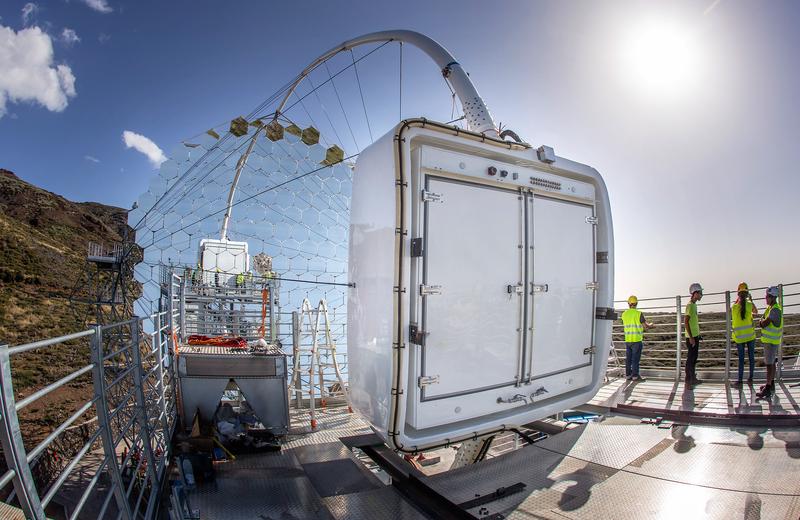
IFAE has also played an important role in the integration of the LST cameras. Work at the institute began in 2019 and continued until 2023, when the cameras were shipped to the Canary Islands ahead of their installation in La Palma. IFAE’s contribution included the overall coordination and integration of camera subsystems, the development of the internal power-supply system and the integration of the trigger system used to distinguish potentially interesting signals from the night-sky background.
Oscar Blanch, a member of IFAE’s Gamma-ray Group, is LST Technical Coordinator and National Coordinator of CTAO-Spain, and has been closely involved in these activities. Otger Ballester, an engineer in IFAE’s Technical Division, worked as System Engineer for the LST and also contributed to the camera-control software, which provides the interface required to operate components developed by different institutes within the collaboration.
Beyond the telescope hardware, IFAE has coordinated the development of the LST Collaboration’s data-analysis software. This work is led by Abelardo Moralejo, a member of IFAE’s Gamma-ray Group, and addresses one of the central challenges of ground-based gamma-ray astronomy: identifying the very small fraction of recorded atmospheric showers produced by gamma rays among the much more numerous events generated by cosmic rays, and reconstructing their energy and direction of origin.
The Port d’Informació Científica (PIC), a scientific-technological centre operated by IFAE and CIEMAT, also plays a key role in the management and preservation of LST data. Since commissioning began in 2018, PIC has hosted a long-term copy of the data produced by the telescopes, currently amounting to around 5 PB, and distributes these data to other computing centres within the collaboration, including CNAF and CSCS.
PIC is also deploying a system that will allow LST users to analyse data directly at the centre through the DIRAC middleware, extending an infrastructure that has so far been used mainly for the production of simulations.
A milestone on the road to scientific operations
The inauguration will mark the completion of the construction of the LST array at CTAO-North, but further work will follow before routine scientific operations begin. The telescopes will undergo an extensive commissioning phase led by the LST Collaboration before being formally accepted by CTAO ERIC. LST-1 is expected to be the first telescope accepted during 2027, opening the way towards early science with the observatory.
- Additional Material
- The Countdown Begins for the Inauguration of the Four LSTs
- IFAE Research group
- Gamma-ray Group
- Contact