







Recognition
2026 Nobel Prize in Physics: the birth of high-energy neutrino astronomy
October 7, 2026
Gamma-ray GroupThe 2026 Nobel Prize in Physics recognises Francis Halzen’s pioneering role in high-energy neutrino astronomy. IFAE is connected to this achievement through MAGIC’s contribution to identifying a likely cosmic neutrino source.
The Royal Swedish Academy of Sciences has awarded the 2026 Nobel Prize in Physics to Francis Halzen (University of Wisconsin–Madison) “for decisive contributions to the IceCube Neutrino Observatory and the discovery of high-energy neutrinos of astrophysical origin”. Halzen championed, from the 1980s, the idea of turning a cubic kilometre of Antarctic ice into a neutrino telescope, and led the international effort that made IceCube a reality. Its detection of neutrinos of cosmic origin, with energies far beyond those reachable in terrestrial accelerators, opened a new window on the Universe and gave access to the most powerful cosmic accelerators.
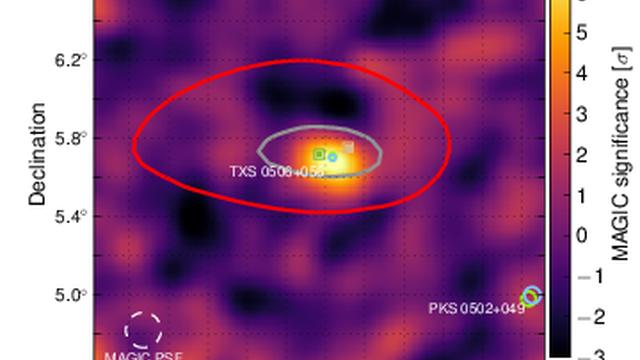
IFAE has contributed directly to one of the field’s landmark results. After IceCube issued the alert IceCube-170922A in September 2017, the MAGIC telescopes made the first very-high-energy gamma-ray detection of the flaring blazar TXS 0506+056. This observation was a key ingredient of the multimessenger evidence, published in Science [1], that identified this blazar as the first compelling source of high-energy cosmic neutrinos. Abelardo Moralejo is among the main authors of that paper, to which he contributed by deriving an upper limit on the source’s redshift from MAGIC data. In addition, the steep spectrum measured by MAGIC is consistent with the internal gamma-ray absorption expected if the ~290 TeV neutrino was produced by photohadronic interactions, which supports a genuine physical link between the two messengers [2].
The institute is also connected to IceCube through people: Gonzalo Merino, Director of PIC, was IceCube’s Computing Facilities Manager between 2013 and 2018.
[1] IceCube, Fermi-LAT, MAGIC et al. (Aartsen et al.) 2018, Science 361, eaat1378 [arXiv:1807.08816]
[2] MAGIC Collaboration (Ansoldi et al.) 2018, ApJL 863, L10 [arXiv:1807.04300]