








Meeting
Spain’s Einstein Telescope community meets in Barcelona to prepare a common roadmap
November 6, 2026
Gravitational Waves GroupIFAE and BSC-CNS brought together around 40 specialists in Barcelona to coordinate Spain’s participation in Einstein Telescope and lay the groundwork for a common roadmap for the future gravitational-wave observatory.
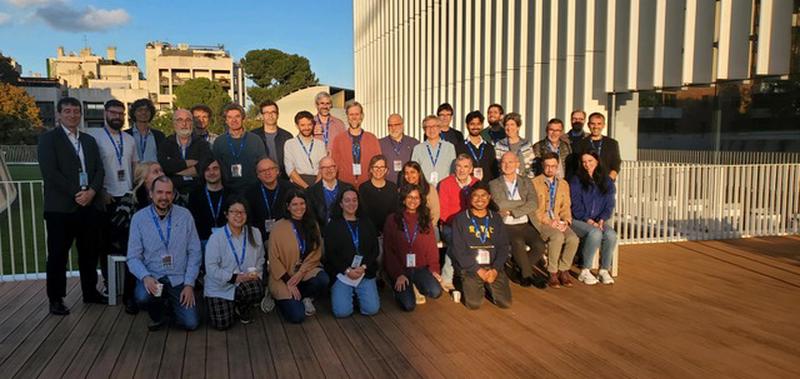
On 4 and 5 November 2026, around 40 researchers and specialists met in Barcelona to coordinate Spain’s participation in Einstein Telescope. The meeting was held at the Barcelona Supercomputing Center – Centro Nacional de Supercomputación (BSC-CNS), which co-organised it with the Institut de Física d’Altes Energies (IFAE), with support from RedOnGra.
Einstein Telescope (ET) is a European project to build a next-generation underground gravitational-wave observatory. Its greater sensitivity will allow researchers to study events such as black hole and neutron star mergers at greater distances than current detectors can reach. ET-Spain brings together teams from Spanish universities and research centres involved in the project to coordinate their scientific and technological contributions.
Teams from across Spain attended the meeting, along with representatives of the project’s international leadership and CERN. The teams presented their work and discussed opportunities to collaborate on the scientific preparations for the observatory, detector development and computing.
The IFAE Gravitational Waves Group, led by Mario Martínez, is a member of the LIGO and Virgo collaborations and contributes to preparations for Einstein Telescope. IFAE coordinated the European ET-PP (Einstein Telescope Preparatory Phase) project, led by Martínez, which laid the scientific, technical and organisational foundations for the future observatory. The institute also participates in ET-COMPASS, which builds on that preparatory work. Mario Martínez is a member of the Einstein Telescope Directorate.
For Virgo, IFAE designed and built two instrumented baffles that have been installed in the detector. Each is equipped with 120 sensors to monitor scattered light and study how the resulting noise affects detector sensitivity. The group also contributes to data analysis and fundamental physics studies within LIGO–Virgo–KAGRA (LVK).
The Port d’Informació Científica (PIC), a data centre operated by IFAE in collaboration with CIEMAT, has provided computing resources and supported data access for LIGO–Virgo–KAGRA (LVK) since 2019. Together with BSC-CNS, PIC has led the work to define Einstein Telescope’s computing and data model and estimate the resources the future observatory will need.
The contributions presented at the meeting will inform a common roadmap to guide Spain’s participation in Einstein Telescope over the coming years.
RedOnGra, the Spanish Network of Gravitational Wave Physics, brings together 20 universities and research centres. The network promotes collaboration and training in the field and aims to strengthen Spain’s participation in international projects such as Einstein Telescope, LIGO–Virgo–KAGRA and LISA.
Milestone
Over 200 Experts Contribute to Einstein Telescope Geometry Comparison Report
October 14, 2026
The report provides a comprehensive assessment of the two possible geometrical configurations for the Einstein Telescope, Europe’s future gravitational-wave observatory, and will inform decisions on its design.
Project
IFAE participates in new European project supporting the Einstein Telescope’s transition to implementation
May 13, 2026
A new European project has been approved to support the transition of the Einstein Telescope (ET) towards its implementation phase, marking another important step in the development of Europe’s future third-generation gravitational-wave observatory.
Event
ET-PP INFRA-DEV Annual Meeting 2026 takes place in Barcelona
May 5, 2026
From 5 to 7 May 2026, the Einstein Telescope Preparatory Phase INFRA-DEV Annual Meeting is being held in Barcelona, hosted by the Institut de Física d’Altes Energies. The event takes place at the UPF Barcelona School of Management.